

The Line
A practical, intuitive tool for clarity and emotional regulation.
Tony Novo
Oct 2024

In leadership, strategy, and decision making, we often focus on tools, techniques, and frameworks to improve performance and develop highly desired leadership qualities like strategic thinking, emotional regulation, grace under pressure, being deliberate, effective communication, and confidence. But what if the most powerful tool is not something you do or have to learn, but something you simply notice?
And what if that something is your own emotional state?
Emotions are constant and unavoidable because of how the brain evolved. Neuroscience confirms that we are always in an emotional state, whether we realize it or not. Emotions shape perception, influence decision-making, and drive behavior, meaning we cannot simply ignore or suppress them. We must recognize and work with them intentionally. We cannot “check our emotions at the door.” What we really meant is show up in the emotions that supports clarity, curiosity, and growth.
Since we are always in an emotional state, and since different emotions affect our thinking in different ways, with some blocking clarity, some distorting perception, and others enhancing creativity and reasoning, the question then becomes…
What emotion do I want to be in?
Enter The Line
Imagine all emotions existing on a spectrum of intensity, grouped into two categories, separated by a line. Emotions above the line make us feel good, while emotions below the line make us feel bad. The further up or down you go, the more intense the emotions become. I use the words “good” and “bad” loosely since emotions are not inherently either, but for the sake of this illustration, we can categorize them based on how they feel.
At any given moment, you are either above the line, or below the line. And this is the first, and most important observation the tool invites.
Are you above the line, or below the line?
When you do this, you immediately detach from the emotion and the way it might “make” you feel or act. You are simply noticing, and in that moment of awareness, you create space to consider a different action or behavior.
When you are above the line, you have access to higher order thinking, you are more. More creative, more strategic, more open, and more connected. You can see possibilities, think with clarity, and engage with others by projecting your awareness onto others, also known as empathy. This is where innovation, problem-solving, and meaningful leadership takes shape.
When you are below the line, your thinking is restricted, you are less. Less clear, less adaptable, less able to see beyond immediate challenges. Decisions become reactive, creativity is stifled, and relationships feel more transactional. In this state, instinct and emotion drive actions, limiting your ability to lead with intention.
The Line as a Tool for Awareness and Choice
The line is a visual metaphor, not a judgment. We all move between states throughout the day.
What matters most is awareness and recognizing where you are in the moment. With this self-awareness, you gain the power to respond deliberately rather than react impulsively.
Above the Line – You access trust, curiosity, and collaboration. This state broadens your thinking and strengthens relationships.
Below the Line – You may feel fear, blame, or frustration. While these emotions serve a purpose, lingering here restricts creativity and empathy.
Referring to the graph below, the triangle shape represents the relationship between emotions and higher order thinking. The further below the line an emotion is, the less access we have to creativity, innovation, strategic reasoning, and empathy. This means that by simply noticing where you are on the graph, you gain insight into how much of your cognitive ability is available to you in that moment.
Awareness alone can shift your state and allow for intentional movement toward clarity, better decision making, and stronger leadership.
Before taking action, ask yourself: “Where am I? Above or below the line?”
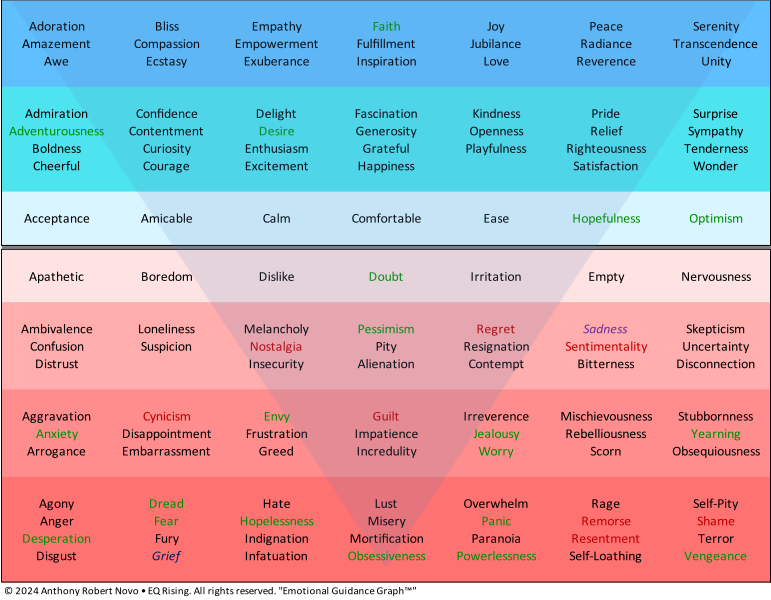
The color bands in the graph represent emotional intensity, while the colored emotions, the words, indicate their relationship to time.
Emotions in green are future-oriented, filled with possibility, optimism, and forward movement. They pull us toward what could be, fueling motivation and creativity.
Emotions in red are tied to the past, often surfacing as regret, guilt, or worry. They can be useful signals, alerting us to something unresolved, but they also trigger stress and cortisol. Staying in them too long can leave us feeling stuck, replaying the past instead of moving forward.
Emotions in purple center around loss, a universal part of the human experience.
This distinction matters because time-oriented emotions shape how we process information and make decisions. Regret, rooted in the past, can lead to hesitation or second-guessing. Anxiety, focused on the future, can drive over-planning or avoidance. Understanding these patterns helps us make choices with greater awareness and intention.
Below the Line Impact on Relationships and Decision Making
When someone lives below the line, their relationships and decision making tend to be shaped by reactivity, control, and emotional distance rather than openness and clarity. Here are some common patterns that emerge:
Relationships Below the Line
Transactional – Relationships feel like exchanges rather than genuine connections.
Superficial – Conversations avoid depth, keeping emotions at arm’s length.
Defensive – Criticism or differing opinions feel like personal attacks.
Control-Seeking – A strong need to manage people, situations, or outcomes.
Low Trust – Constant doubt, second-guessing, and assuming bad intent.
Frequent Conflict – Arguments arise easily, often fueled by blame or frustration.
Avoidance of Vulnerability – Sharing emotions feels unsafe, leading to emotional walls.
Passive Aggression – Needs and frustrations are expressed indirectly.
Fear-Based Interactions – Decisions and conversations are driven by insecurity or scarcity.
Lack of Empathy – Little effort to understand or consider others’ perspectives.
Decision Making Below the Line
Reactive – Decisions are made quickly based on fear, stress, or immediate relief.
Short-Term Focused – Choices prioritize immediate survival over long-term growth.
Avoidance-Based – Hard decisions are put off due to fear of discomfort or failure.
Risk Averse – Overly cautious, preferring certainty even at the cost of opportunity.
Emotionally Charged – Choices are driven by anger, frustration, or anxiety rather than reason.
Rigid Thinking – Stuck in old patterns, resistant to new perspectives.
Approval Seeking – Decisions are shaped by the fear of judgment rather than what is best.
Blame-Oriented – Looks for external reasons for problems rather than solutions.
Control-Driven – A need to dictate outcomes rather than adapt to changing circumstances.
Low Self-Trust – Second-guessing leads to hesitation and indecision.
Above the Line Impact on Relationships and Decision Making
When someone lives above the line, their relationships and decision making are shaped by openness, trust, and intentionality rather than fear or control. Here are some common patterns that emerge:
Relationships Above the Line
Authentic – Connections are based on honesty and mutual respect.
Deep and Meaningful – Conversations go beyond the surface, allowing for real connection.
Open and Receptive – Feedback is welcomed as an opportunity to grow.
Trust-Based – Assumes good intent, fostering confidence and collaboration.
Constructive Conflict – Disagreements lead to learning and stronger relationships.
Emotionally Safe – Vulnerability is seen as a strength, not a risk.
Clear and Direct Communication – Needs and concerns are expressed openly.
Curiosity-Driven – Seeks to understand others rather than judge them.
Empathy-Rich – Considers multiple perspectives and emotions in decision making.
Mutually Supportive – Encourages and uplifts others without competition or control.
Decision Making Above the Line
Intentional – Decisions are made thoughtfully, considering long-term impact.
Big-Picture Focused – Balances immediate needs with long-term vision.
Courageous – Faces hard decisions directly, even in uncertainty.
Opportunity-Oriented – Looks for potential and possibility rather than just risk.
Emotionally Balanced – Recognizes emotions but does not let them dictate choices.
Adaptable – Open to new perspectives and flexible when circumstances change.
Values-Driven – Choices align with personal integrity and core beliefs.
Self-Assured – Trusts one’s own judgment while remaining open to feedback.
Empowered – Makes decisions from a place of confidence rather than fear.
Strategic – Thinks multiple steps ahead, considering both logic and human dynamics.
Empathy is Strategic Thinking
One of the most misunderstood abilities of the human mind is empathy. It is not a soft skill, nor is it a sentimental trait to be sidelined. Empathy is a higher order cognitive function, a product of the neocortex, and a fundamental part of strategic thinking. Senior leaders who dismiss it are operating at a disadvantage.
Why? Because when empathy is fully engaged, there is no conflict. Conflict exists in the absence of understanding. Empathy allows you to see not just the limitations, motivations, and constraints of an opponent, team, or constituency, but also their possibilities and opportunities. You may not agree with them, but you know them, and that is where real strategy begins.
Empathy sharpens thinking. It helps us anticipate, strategize, and move with clarity, shifting from reacting to leading with intention.
More on the Brain
The brain has evolved in three distinct layers, each serving a different role. The reptilian brain, emerging 500 million years ago, governs instincts and survival responses like fight, flight, freeze, and appease. It also regulates heart rate, breathing, territorial behavior, and habitual patterns that run automatically. The mammalian brain, developing 200 million years ago, introduced emotions, social bonding, and more complex decision-making. The neocortex arrived much later, about two to three million years ago, and has undergone significant changes, particularly in the last 100,000 years. During this period, it expanded rapidly, refining higher-order thinking, creativity, rationality, values, time awareness, and most importantly, empathy.
Even though awareness and rational thought are what we strive for in leadership, they are often at the mercy of brain chemistry and the way the brain prioritizes survival. The lower brain reacts first, shaping perception and response before the neocortex has a chance to engage. While logic and intention are powerful tools, they do not come easily, they must be nurtured and reinforced through deliberate practice to overcome the fast, automatic instincts of the lower brain.
The Intoxicating Emotion of Anger
Emotions are predispositions to act, each one pushing us in a specific direction. Because emotions vary, the actions they drive also differ.
Anger arises from a sense of injustice and drives us to seek justice. It can feel powerful, even intoxicating, especially when life seems unfair. Unlike fear or uncertainty, which can feel raw and uncontainable, anger provides a sense of decisiveness and control. This is why people hold onto it. It makes sense, and in many ways, it feels better than the discomfort of fear, ambiguity, or helplessness. But like alcohol, anger’s intoxicating pull comes at a cost. If we stay in it too long, it consumes us.
Intense emotions like anger and fear also significantly narrow perception. They create tunnel vision, stripping away creativity, innovation, and strategic thinking in favor of immediate action. They focus us, but in doing so, they shut out empathy completely, making it impossible to see beyond the immediate threat or injustice. This is why emotions are powerful, but also why learning to recognize and regulate them is essential for leadership, decision-making, and meaningful connection.
Anger and Leadership
Anger can feel like a strong leadership tool for some because it creates focus, urgency, and a sense of control. However, true leadership requires expansive thinking, problem-solving, and long-term strategy, which anger eventually blocks. While it may provide a strong initial response, staying in it limits a person’s ability to find solutions and cuts off empathy entirely. Without empathy, we lose the ability to understand different perspectives, build trust, and navigate complexity with care.
Sadness and Loss
Sadness signals the loss of what mattered. Unlike emotions that push toward action, sadness invites pause. It doesn’t demand fixing or solving. It asks for presence.
Many resist sadness because it feels heavy and uncomfortable. But because loss is inevitable, sadness is necessary. It creates space to process grief, honor what was, and, over time, move toward greater depth and meaning.
Sadness and Leadership
Workplaces weren’t designed to hold space for grief. Emotions were treated as distractions rather than part of being human. But grief doesn’t disappear when ignored.
Acknowledging loss, whether personal or professional, creates trust and psychological safety. It makes space for real resilience. Leaders who can be present with sadness, in themselves and others, create conditions where people can show up fully without pretending everything is fine.
Attributions & Influences Behind The Line
The Line concept is a blend of multiple disciplines, models, and thought patterns, developed over 30 years of personal and professional growth. It was created to offer a simple yet powerful tool for leadership, decision-making, and self-awareness, integrating insights from coaching, neuroscience, psychology, and leadership development. The following influences played a key role in shaping it:
Executive & Leadership Coaching – Inspired by clients’ need for a practical, intuitive tool, The Line helps cultivate a clear mind, which is at the core of effective leadership behaviors and qualities.
More to Life (formerly Life Training in London) – Introduced the question “Are you clear?”, linking clarity of thought to freedom from negative emotions (below the line).
David Hawkins MD., Ph.D. (Power vs. Force) – Demonstrated that emotions carry energy, influencing both personal and collective power. Certain emotions (below the line) make things feel forced and difficult, while others (above the line) create flow and ease.
Positive Intelligence (Shirzad Chamine) – Introduced the contrast between Sage vs. Saboteurs, reinforcing the idea that self-awareness shifts us from limiting patterns (below the line) to higher-order wisdom (above the line).
Neuroscience & the Triune Brain Model – While the Triune Brain model has evolved, it still highlights the distinct roles of the reptilian, mammalian, and human brain in shaping our emotions, instincts, and cognition. The Line reflects how the lower brain reacts, while the higher brain chooses.
Ontological Coaching – Ontological coaching teaches that emotions are not just feelings but active forces that shape perception and behavior. Each emotion naturally predisposes us toward action, as anger compels us to fight, fear pushes us to retreat, and joy encourages connection. Recognizing this allows us to shift from reactive patterns to intentional choices, making emotions a tool for leadership rather than a limitation.
The Power of Now & Internal Family Systems (The Observer) – Emphasizes the ability to step back and observe emotions from a detached perspective, reducing their immediate grip and allowing for intentional, above-the-line thinking.
Foundational
The Line
A practical distinction between reactive and intentional leadership, and how moment-to-moment choice shapes outcomes under stress.
Presence and Regulation
Centeredness
What it means to remain grounded in the middle of complexity, and why centered leaders create clarity for others.
Meditation for Leaders
A pragmatic look at meditation as a capacity-building practice, not a spiritual exercise, and how it supports judgment and resiliance.
Trust, Loyalty, and Relational Dynamics
The Intelligent Use of Trust
Trust as a strategic and ethical choice, not a blanket virtue, and how discernment protects both performance and people.
Loyalty Has a Long Shadow
An examination of loyalty’s upside and its hidden costs, especially when unexamined loyalty conflicts with truth, agency, or care.
Foundational, Emotional Regulation
The Line
A practical distinction between reactive and intentional leadership, and how moment-to-moment choice shapes outcomes under stress.
Presence, Resilience, Clarity
Centeredness
What it means to remain grounded in the middle of complexity, and why centered leaders create clarity for others.
Meditation for Leaders
A pragmatic look at meditation as a capacity-building practice, not a spiritual exercise, and how it supports judgment and resiliance.
Trust, Loyalty, and Relational Dynamics
The Intelligent Use of Trust
Trust as a strategic and ethical choice, not a blanket virtue, and how discernment protects both performance and people.
Loyalty Has a Long Shadow
An examination of loyalty’s upside and its hidden costs, especially when unexamined loyalty conflicts with truth, agency, or care.